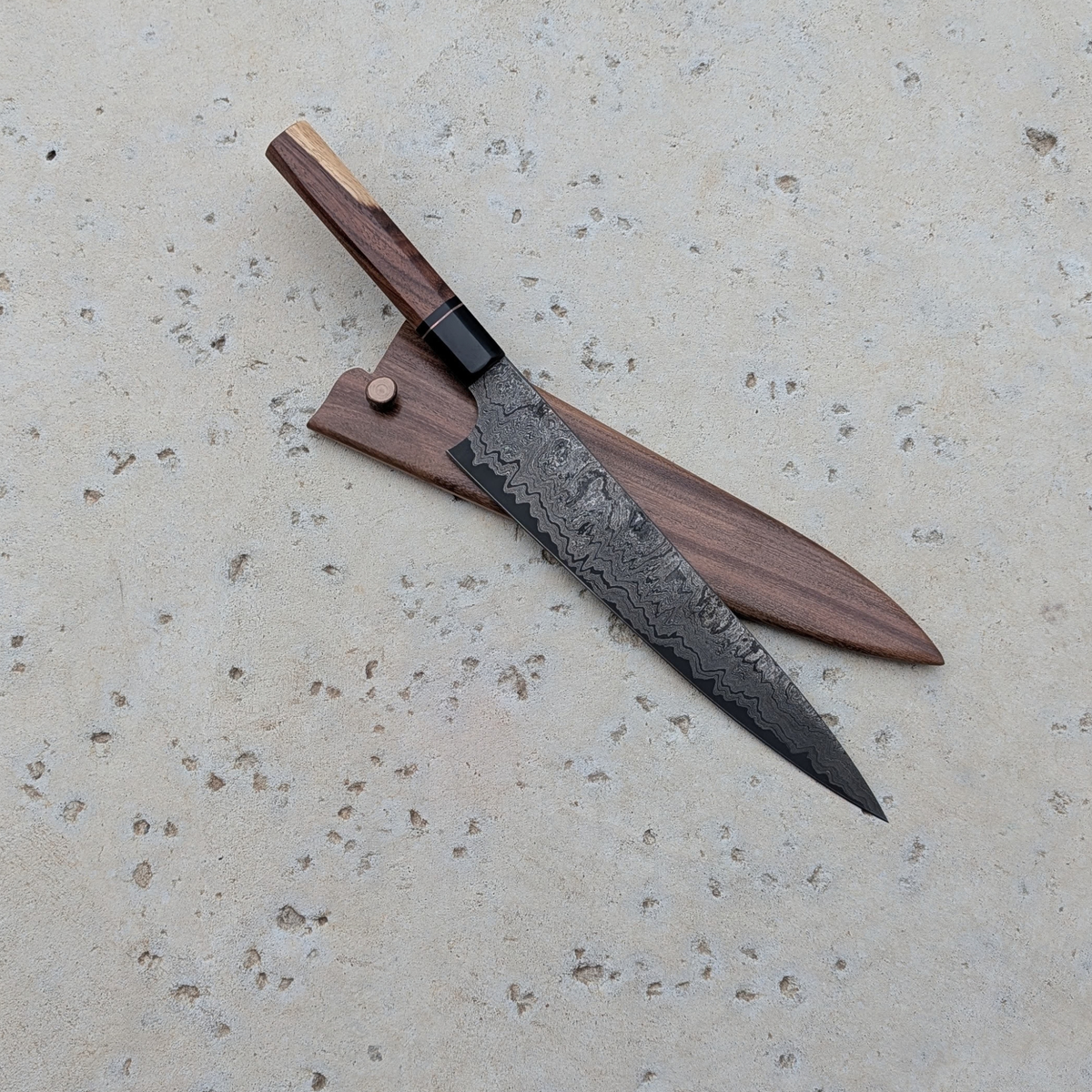
Gyuto 260mm, Damascus San-Mai #Gy7105
Free U.S. shipping on orders over $500
Couldn't load pickup availability

Materials
Materials
Handle Materials: Acacia wood, black high-density composite collar, with copper spaser
Saya Materials: Handcrafted matching Acacia wood with securing pin .
dimensions
dimensions
Blade Length: 260 mm
Overall Length: 410 mm
Handle Length: 140 mm
Knife Weight: 222 g
Weight with Saya: 300 g
care instructions
care instructions
. Everyday Use & Cutting Etiquette
Cutting Surfaces: Always use end-grain wood, edge-grain hardwood, or soft rubber/synthetic cutting boards. Never cut on glass, ceramic, marble, granite, or stainless steel worktops.
Intended Use: High-performance culinary blades feature acute, precise bevels designed for clean slicing. Avoid using chef and utility knives to chop through frozen items, dense bone, or thick woody shells.
Technique: Avoid twisting, scraping, or prying with the apex on the cutting surface. Scrape food off the board using the spine of the blade, never the sharpened edge.
2. Washing, Drying & Patina Development
Hand Wash Only: Never place your knife in a dishwasher. Harsh alkaline detergents, extreme heat cycles, and rattling against other silverware will dull the edge, strip handle finishes, and corrode high-carbon steel.
Immediate Cleaning: Clean immediately after use with warm water, a mild dish soap, and a soft sponge. Avoid abrasive scouring pads or steel wool on etched or polished blade faces.
Dry Thoroughly: Hand dry the entire blade and handle immediately with a clean, dry towel. Never leave the knife sitting in a wet sink or drying rack.
Understanding Patina: High-carbon cores and unclad high-carbon steels will naturally react with acidic foods (citrus, onions, tomatoes, proteins). This develops a protective, gray-blue oxidation layer called a patina, which adds character and guards against red rust.
3. Oiling, Handle Care & Storage
Blade Corrosion Protection: If storing the knife for an extended period or living in a humid environment, apply a drop of food-safe mineral oil or 100% pure camellia oil across the entire blade surface, wiping off any excess with a soft cloth.
Handle Nourishment: Natural hardwood handles benefit from an occasional rub-down with mineral oil, beeswax, or cutting board butter to preserve moisture and prevent drying or shrinkage.
Storage Options: Store your dry knife on a wooden magnetic strip, inside an individual wooden saya (sheath), or in a felt-lined knife roll/block. Avoid loose drawer storage where edges contact other metallic utensils.
4. Sharpening & Edge Maintenance
Touch-Ups: Maintain edge alignment between sharpening sessions using a medium-fine whetstone.
Resharpening: Sharpen on quality waterstones or fine Japanese natural whetstones (JNATs) to maintain blade geometry and preserve thin core steel life. See our selection of curated, authenticated and tested Natural Japanese whetstones.
Share