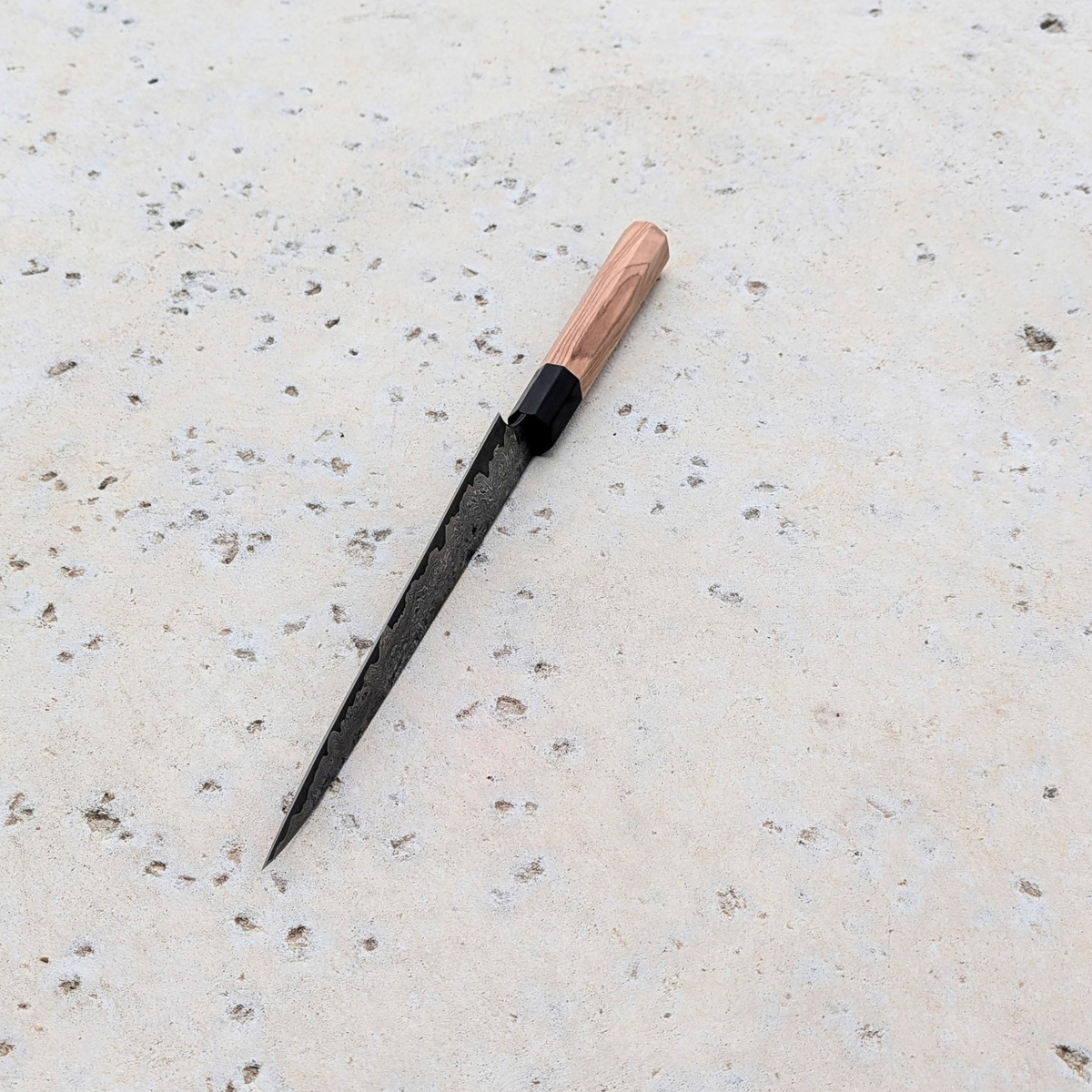
Sujihiki 205mm, Damascus San-mai, Olive Handle #Suj5703
Sujihiki 205mm, Damascus San-mai, Olive Handle #Suj5703
Free U.S. shipping on orders over $500
Couldn't load pickup availability
 Military & First Responders get a 10% discount! Click to verify.
Materials
Materials
dimensions
dimensions
Hand-Forged 205mm Damascus San Mai Sujihiki
The traditional Japanese "muscle cutter," purpose-built for clean, single-draw portioning, trimming, and carving.
At 205mm, this blade bridges the gap between a full-sized 270mm banquet carver and an agile line knife—providing enough cutting edge for boneless proteins while maintaining surgical control on compact cutting boards.
Performance & Slicing Dynamics:
Low-Drag Profile: The narrow blade height minimizes surface area contact and lateral suction against dense meats, raw fish, and cooked roasts.
Dead-Straight Tracking: Symmetrical double-bevel geometry ensures the knife pulls straight through tissue without steering or wedging off-center.
Clean Tissue Separation: Designed for extended pull-cuts rather than rocking, preventing the tearing, crushing, or juice loss typical of wider chef's knives.
Blade Specifications:
Pattern & Construction: Hand-forged San Mai lamination with high-contrast Carbon Damascus cladding over a solid high-carbon o1 tool steel core.
Edge Length: 205mm (approx. 8 inches) cutting edge from heel to point.
Aesthetics: Flowing Damascus pattern-welding "blackout" etched to reveal high-contrast lines and an organic lamination boundary.
Handle & Balance:
Geometry: Octagonal wa-handle offering tactile indexing and lateral stability during long horizontal draws.
Materials: Dense natural Olive wood handle fitted with an African ebony collar.
Balance: Neutral to slightly blade-forward, allowing the knife's own weight to carry the draw through the protein.
Recommended Applications:
Slicing cooked steaks (ribeye, strip, tenderloin), duck breasts, and smaller roasts.
Precision fabrication: trimming sinew, silver skin, fat caps, and portioning raw loins.
Sashimi, crudo, and cured meats requiring clean, glossy facet cuts.
care instructions
care instructions